
NEWS CENTER
The company has always adhered to the "integrity, team, hard work, innovation" concept of the company, and constantly
surpass themselves. In line with the purpose of taking advantage of the society and serving the society, we will develop
together with our friends.
Technology: Quality control methods for eight different paper prints in the printing process
time:
2021/01/09
Source:
http://news.naliyin.com/info_14704
in the packaging and printing process, different materials are often used to print the same or similar layout, such as the internal and external packaging, trademarks, instructions and other series of printed products. generally, the color design of the graphic or logo of the printed layout is basically the same. however, due to the differences in the characteristics of the substrates, the printing equipment, ink performance and process form used by some products are not necessarily the same, and customers often require the printing color of the series of products to be basically consistent, and there can be no obvious color difference. The actual production process shows that there is a certain degree of difficulty in controlling the ink quality of a series of prints made of different materials, which requires careful design of process technology and careful control of operation technology in order to obtain better printing quality results and meet the quality requirements of customers.
The characteristic analysis and process determination method of 1. series printed matter
the so-called series of printed matter refers to the same 1 kinds of products with different specifications or complete sets of products using different printing materials, but the graphic layout structure or color is the same or similar. Due to differences in material characteristics or printing layout specifications, the adaptability of the printing process is also very different. For example, the corrugated box and color box surface printing materials for the outer packaging include white board paper, kraft card or boxboard paper, while the carton packaging materials include white board paper, kraft card, white card, glass card, copperplate card, PE coated paper, flexible packaging plastic film, cellophane paper, tissue paper, glossy paper, copy paper, offset paper, vacuum aluminized paper, laser paper, etc. Corrugated board thickness, surface flatness characteristics, as well as PE coated paper, plastic film, cellophane, tissue paper, vacuum aluminized paper printing process, from the material characteristics and product packaging safety, health quality considerations, suitable for flexographic printing with water-based ink, can better ensure the quality of products. For the pre-printing process of color box face paper, color box printing of white board paper, kraft card; vacuum aluminized paper, laser paper and other materials, a large number of gravure or flexographic process can be used, can make the printing quality and production costs are better balanced. For white board paper, kraft card, white card, glass card and copperplate card products with a quantity of about 100000 printing, as well as glossy paper, copy paper, offset paper, vacuum aluminized paper and laser paper, offset printing process is more suitable. Among them, glossy paper and copy paper have low quantitative, which are not suitable for high-speed automatic paper feeding. Low-speed 01 offset press can be used for printing, so as to better ensure the overprinting quality of products.
2. should pay attention to the process technology control of prepress layout
now a lot of printed matter is provided by customers with their own design or advertising company design, production of electronic manuscripts, because they do not fully understand the printing process, often resulting in the production of manuscripts, can not meet the requirements of the printing process. Take a series of printed matter with the same reticulated structure layout as an example, due to the different printing materials used, the printing color will be quite different. It is the two products of paper plate (white board paper material) and paper cup (single-sided PE coated paper) that are also printed by offset printing process. Due to the good surface smoothness of white board paper material, the ink absorption is less, while the surface of single-sided PE coated paper is relatively rough and the ink absorption is larger. If these two materials are used to print the layout with the same screen structure, the colors will differ greatly, generally, the printing color of single-sided PE coated paper is obviously lighter than that of white board paper, and the color difference problem caused by the difference in printing performance of materials cannot be better overcome by the adjustment of ink quantity and pressure. Generally, the main color dot area of single-sided PE coated paper should be appropriately adjusted to be larger through plate-making design, so as to make the printing color close. Therefore, when receiving a series of printed matter with the same screen layout structure and different printing materials, it is necessary to carefully analyze the original layout structure and the characteristics of the substrate material, and then determine a reasonable plate-making design scheme, that is to say, according to the gloss of the material and the printing ink absorption performance, the dot area of a certain 1 of product layouts should be reasonably adjusted to ensure that the colors printed by different materials are close to each other.
3. should pay attention to the process technology control of the imposition direction
for printed matter with multi-imposition structure, several different kinds of layouts are usually spelled on a printing sheet. if the differences in printing colors of different varieties are not considered, and different varieties with large color differences are spelled on the same longitudinal direction, it is difficult to adjust the ink output locally through the ink bucket once the printing colors of one of the 1 kinds of layouts on the longitudinal layout are too light or too dark, in order to realize the ink color control of a certain variety layout of the corresponding vertical layout, the ink color adjustment often occurs at the expense of one another, and the printing color of the vertical overall layout cannot be taken into account. Therefore, for multi-imposition of paper plates, paper cups, trademarks and other products, each longitudinal position is best to spell the same variety or color close to the variety, in order to facilitate the effective adjustment of the amount of ink coating. Do not spell several products with large color contrast in the same longitudinal direction, because such imposition printing is most likely to produce color difference. Even if the printing color can be controlled through the adjustment of ink coating amount, it is easy to produce chain printing quality problems, such as paper hair, paste plate, dirty plate and other adverse conditions.
4. adjust the dot size by printing process
The main feature of the series of printed matter is that the graphics are basically the same, only the size difference, and the characteristics of the substrate material are completely different. If the film reticulation structure that has been made is the same, it can be considered to properly control the exposure time of the main color plate of a certain 1 of products according to the gloss and ink absorption of the substrate plate in the printing process to realize the adjustment of dot size. Taking the substrates of series products as examples, there are two kinds of glass cards and offset paper. The offset paper layout is relatively rough and has a large amount of ink absorption. The exposure time of the main color plate can be appropriately shortened to achieve the purpose of increasing the dot area. Only in this way can the ink color of the printed offset paper print layout be close to the ink color of the glass card print layout, and paste defects are not easy to occur. However, it must be pointed out that there is a limit to adjusting the dot size by the printing process, and it can only be adjusted in a small amount. If the exposure time is too short, the dark white dots on the layout are prone to paste death, and the layout layering is poor. Therefore, the exposure time adjustment should master the appropriate degree. For example, the original normal exposure should be 140S, and the shortened exposure time should be controlled between 110-120S.
5. control the printing color by adjusting the printing pressure
printing pressure is the medium of imprinting transfer. the size of printing pressure directly reflects the depth of printing ink, especially in letterpress printing process. the size of pressure has a great influence on the depth of printing ink. when the printing pressure increases, the printing color will deepen. on the contrary, if the printing pressure is reduced, the printing color will appear lighter. For a series of printed matter of different substrates, when the surface of the printed material is rough, the printing pressure can be appropriately increased to deepen the printing color, so that the color of the printed matter of different materials is close. However, the printing pressure adjustment should also be controlled to an appropriate degree. Excessive pressure adjustment is easy to accelerate the wear of the printing plate, and it is easy to produce chain quality problems such as paste plate and printing plate enlargement and deformation. This is a problem that should be paid attention to during the operation of the printing process. General relief printing pressure increase adjustment, not more than 30 silk, otherwise, the printing deformation will directly affect the quality of the product.
6. control printing color by adjusting ink hue
four-color printed matter is printed with standard four-color ink according to the regular process. however, if there is obvious difference in a certain color and the color requirement cannot be met through ink quantity adjustment, appropriate adjustment of the ink hue of a certain color can be considered to make the printed product ink color meet the requirements of the original color. For example, when we print a four-color trademark at one time, the light orange layout color after overprinting has obvious reddish color, and the yellow hue has obvious insufficient feeling, which is quite different from the original color. However, the reduction of M color ink amount and the increase of Y color adjustment are limited and cannot be adjusted to the requirements consistent with the original ink color. In this case, it seems that the effective color adjustment effect can only be achieved by appropriately reducing the dot area of the M version and increasing the dot area of the Y version. However, this is very labor-consuming and time-consuming, and will increase economic costs, which is not desirable. Through careful analysis and research on the printing samples, the author found that in the whole layout, except for the overprinting relationship between the Y color part of the flat screen and the M color plate of the flat screen, the M color plate did not have a single monochrome color printing result. Therefore, the author germinated in the ink of & ldquo; Four-color red & rdquo; Part of the ink of & ldquo; Four-color yellow & rdquo, composition of special spot color red ink for overprinting, through this treatment, light orange overprinting layout, printing color immediately achieve the effect of similar to the sample color, so that the printing color of the product finally meet the requirements of customers. By the same token, in the printing of different materials of a series of printed matter, often because of the different materials and the hue of a 1 of the main color of the obvious shallow situation, this, can consider the use of a color of the ink hue for appropriate adjustment, to achieve the correction of printing ink, this is also the most simple and quickest method.
7. use of different printing process characteristics to control printing color
due to the differences in the printing process, the thickness of the printed ink layer is also significantly different. for a series of printed materials with large differences in materials, it is also the 1 effective way to control the printing color by selecting a suitable process for printing according to the adaptability characteristics of the printed layout color and materials to the printing process. The thickness of the ink layer for various printing processes is about: offset printing 3 & mu;m; Embossing 8 & mu;m; Flexo printing 10 & mu;m; Gravure printing 12 & mu;m; Silk screen 30 & mu; M, according to the basic performance of the substrate, surface gloss, ink absorption, and layout pattern structure, etc., the printing process suitable for the ink absorption characteristics of the substrate material can be selected as appropriate. The offset printing process is limited by the balance of ink and ink, and the adjustment range of ink coating is small, which is more suitable for printing substrates with relatively good gloss, such as coated paper, glass card, white card, offset paper, white board paper, kraft card, etc. The napkin soft texture, ink absorption, tensile strength is poor, easy to stretch deformation, is more suitable for the use of low viscosity liquid water-based ink for printing, in order to obtain the ideal printing color, and water-based ink has a great advantage in environmental protection, so the use of flexographic printing napkin is the best choice. The choice of printing process should not only consider the influence of the printing characteristics of the substrate on the printing color, but also consider the printing production cost, such as gravure, flexographic plate making process, which is more suitable for printing long-term products.
8. the quality control method of different material series printed matter
Due to the limitation of the production scale of the printing factory, if some factories have only a single flexo printing process, and some factories have a single offset printing process or gravure printing process, many series of printed materials are often sent to several factories for printing. Due to the production cost, some customers do not adopt proofing technology, and often use the first printing sample of one 1 of materials as the color reference sample of the other 1 of materials of printing. For example, using the first printing flexo napkin as the reference sample for printing colors of offset white board paper plates or coated paper cups brings certain difficulties to printing color control, and offset printing is often difficult to keep up with the ink color of flexo printing. Because the flexo ink layer is thick, and the adjustable range of the offset ink layer is relatively smaller than the flexo printing process. Therefore, with different processes for printing series of printed matter, it is appropriate to arrange the products using offset printing process to be printed first, and the products using flexo printing, gravure printing or silk screen printing to be printed later, so as to facilitate the control of the color of series of printed matter. If the same offset printing process is used to print products of different materials, consideration should be given to printing materials with good gloss first, and materials with poor gloss should be printed later. Because of the good gloss material, the size of the printing ink control is relatively accurate, which can reduce the probability of large deviation of the printing color. It is worth mentioning that the printing draft is used as the comparison of printing colors. Attention should be paid to the influence of the light transmission performance of the sample materials on the visual identification of colors. For example, the film printed matter and napkin printed matter have high transparency and should be placed on the standard stand side by side with the printing samples for identification.
to control the color of series of printed materials of different materials, we need to pay attention to the comprehensive consideration of material characteristics, printing process technology and equipment operation adjustment, and through careful technical analysis of the original, and then determine the appropriate production process scheme, which can not only avoid the blindness of the production process, reduce the occurrence of printing defects, but also better ensure the printing quality of products and effectively improve the production efficiency.
Related News
2020-06-12
The convenience of label and the development of label printing
The emergence of labels has greatly improved work efficiency and accelerated the pace of urban life. In the face of various printing methods, in order to shorten the equipment debugging time, improve productivity, improve product quality to a certain extent, and meet the needs of customers, label printing factories generally classify products according to different grades and different batches of daily necessities. Then use different printing methods for printing.
2019-08-05
Under the background of "new engineering", the training of printing professionals has new ideas!
In order to study, publicize and implement Xi Jinping's thoughts on socialism with Chinese characteristics in the new era and the spirit of the 19th National Congress of the Communist Party of China, implement the deployment of the National Propaganda and Ideological Work Conference, and undertake the mission of "raising the banner, gathering people's hearts, cultivating new people, promoting culture, and exhibiting image" The printing industry better serves the prosperity and prosperity of my country's socialist culture and leads high-quality development. The National Press and Publication Administration hosted the China Printing Industry Innovation Conference, build a political position that dominates development and a service platform for collaborative innovation. The theme of this year's conference is "focusing on greening", organizing and mobilizing the strength of the whole industry to jointly participate in the preparation and holding of the conference, preaching policies and regulations, and informing development
2019-08-05
Break down technical barriers! China's inkjet print head can no longer rely on foreign technology
A few days ago, the ZTE incident came to life after a storm. This crisis without gunpowder smoke has triggered a discussion among Chinese people about independent core technologies. In fact, in the 3D printing industry, there are many domestic technology subject to foreign, piezoelectric inkjet print head is one of them. China's "storm" strong counter-attack piezoelectric inkjet print head in the sand 3D printer, as the chip in the semiconductor, the importance is self-evident. Previously, companies such as German Voxeljet and Exone in the United States have already had relatively mature commercial applications in sand mold 3D printing technology, while Chinese companies limited to nozzles have few brands.
2019-08-05
Digital printing will cross the label, rapid development in all areas of packaging
Mr. MichaelFairley believes that label processors still have time to find new business opportunities in the production of flexible packaging and folding cartons with their understanding, expertise and skills in digital printing. At the 2019 Asia International Label Printing Exhibition (LabelexpoAsia2019) held at the Shanghai New International Expo Center from December 3 to 6 this year, about 30 digital printing equipment-related manufacturers participated in the exhibition, including: u.S. Amica (Amica), Domino, Dilli, Haotian, Konica Minolta, Runtianzhi, Yunbo (Shanghai) Internet of Things Technology, Changzhou Temine, Hefei Runjie, Nebula Computer (GCC), Hanhua Industry, Saikang, Zhuo Jue, Dragan and Ningbo Worry, etc. Among these exhibitors, the use of inkjet technology accounts for the vast majority, thanks to the rapid development of nozzle technology, the improvement of printing materials and ink formulations, and the unprecedented progress made by color inkjet printers in terms of performance and market applications. The development of digital printing in the label industry has been more than 20 years. The first to enter this field was toner technology, followed by inkjet technology, and now Landa's nano digital printing technology. This is 20 years of rapid development. So far, the global label industry has installed about 4500 digital printing machines, of which HPIndigo and Saikang toner printing machines account for more than 2/3 of the total installed capacity.

Head office: Guangzhou Guangcai Label Co., Ltd.
Address (Add): No.2, Wei Da Lu, Dazhou Village, Shibi Street, Panyu District, Guangzhou
Foshan Branch: Guangdong Guangcai Label Co., Ltd
Address (Add): 8th Floor, Building 15, Haichuang Dazu Robot Manufacturing Center, No. 3 Erzhi Industrial Avenue, Xihai Village, Beijiao Town, Shunde District, Foshan City
Shanghai Branch: Guangcai Label (Shanghai) Co., Ltd.
Address of Shanghai Branch (Add): Building 4, 626 Baoyuan Fifth Road, Jiading District, Shanghai
Jiangxi Branch: Guangcai Label (Jiangxi) Co., Ltd
Jiangxi Branch Address (Add): Within the Pharmaceutical and Chemical Industry Base of Tianfan Street Industrial Park, Poyang County, Shangrao City, Jiangxi Province
Wechat Public
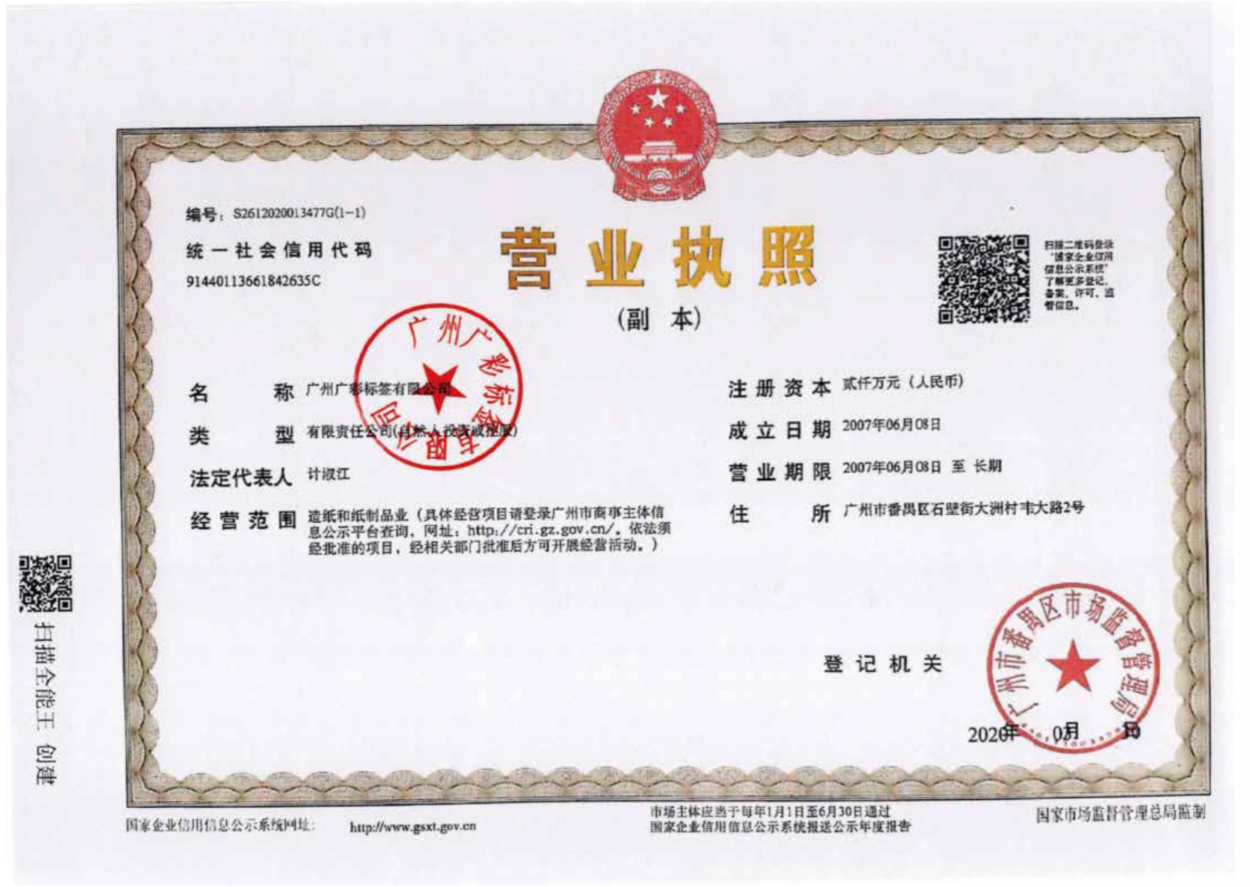
Copyright©2023 Guangzhou Guangcai Label Co., Ltd. ALL RIGHTS RESERVED. | SEO Tags | Business License | Cloud information | city substation
Copyright©2023 Guangzhou Guangcai Label Co., Ltd. ALL RIGHTS RESERVED. | SEO Tags | Business License | Cloud information | city substation