
NEWS CENTER
The company has always adhered to the "integrity, team, hard work, innovation" concept of the company, and constantly
surpass themselves. In line with the purpose of taking advantage of the society and serving the society, we will develop
together with our friends.
Winter adhesive label use matters needing attention
time:
2018/05/10
Source:
Guangzhou Guangcai Label Co., Ltd.
In a cold environment, the viscosity of the self-adhesive material has the characteristic of weakening as the temperature decreases. The quality of the sticker is closely related to the external environment, especially the external temperature, which has a greater impact. Generally speaking, the temperature is too high or too low will make the sticker label paste not strong. Therefore, when pasting self-adhesive labels in winter, we have a lot of things to pay attention.
the 1. labeling ambient temperature should meet the product requirements: normal labeling should be carried out under the condition that the labeling temperature (10 ℃-25 ℃) is met, and the products with adhesive labels can be used within the use temperature range (generally -5 ℃ -40 ℃) after 24 hours. Any 1 kind of self-adhesive material has a related labeling temperature. Below this temperature, the stickiness of the self-adhesive glue is limited, which will lead to problems such as weak labeling and warping.
2. label storage environment temperature should not be too low: self-adhesive printing materials placed in the outdoor or cold environment, it is easy to cause the material, especially the glue part is frostbite. If not properly restored, the stickiness and processability of the adhesive will be lost or lost.

3. tag presets: This is important in cold regions. If the temperature of the label itself is low due to the transportation and storage conditions that cannot meet the requirements, or even frostbite, although the labeling environment temperature meets the requirements, the viscosity and processing performance will also be affected due to the inability to recover in time. Therefore, in the above case, before the processing or labeling operation, the label material should be preset in the labeling environment for a period of time (more than 24 hours), so that the temperature of the label material itself will rise, so that the adhesion and processing performance are restored.
When 4. labeling, pay attention to: labeling pressure control and cleaning of the surface to be applied. A suitable labeling pressure can ensure that the air between the label and the surface to be attached is discharged. Thus, the label is attached firmly and smoothly. The cleanliness of the attached surface is also an important factor in ensuring the stickiness of the label and the smoothness after bonding.
5. After the labeling is completed: The stickiness of the label printing material usually takes a period of time (usually 24 hours) to gradually reach the highest value. In addition, film labels and containers will expand and contract due to temperature changes, while paper labels are more prone to moisture or water loss and deformation of paper fibers. These changes are not conducive to the glue to play the best labeling performance.
example:
example 1: a veterinary drug production plant, water needle production line labeling, labels in the labeling process, there is a serious "flying label" phenomenon (labels on glass bottles immediately fall off), some labels after sticking, 1 by external force, and immediately fall off, the label can not be used. After the after-sales service personnel of our company went to the customer's production site to understand: there is a layer of water mist on the surface of the water needle glass bottle, and there are water droplets in serious places.
Solution: Reheat and dry the glass bottle with water mist and water droplets before use. The phenomenon of "flying label" disappears, and the labeling quality is qualified to meet the normal production.
analysis: the surface of the object (glass bottle) has water mist and water droplets, which cannot meet the labeling requirements.
example 2: when labeling, the labeling environment and temperature of a pharmaceutical factory meet the requirements of normal labeling, and there are no beads on the object (glass bottle), but the label cannot be affixed during labeling production. After investigation, it was found that the surface of the glass bottle had a layer of impurities that were not easy to see.
Solution: Reprocess this batch of glass, remove impurities, and the labeling production will proceed normally to meet the labeling quality requirements.
Analysis: This is due to impurities on the surface of the object.
example 3: a brand production factory, labeling in the environment of 0 ℃ ~ 5 ℃, self-adhesive label adhesive frostbite, hardening, resulting in labels can not be used, the specific performance is: due to label hardening, part of the label in the labeling machine turning part separation or fall off, affecting the normal labeling. Due to the loss of adhesive viscosity, the label attached to the plastic barrel is warped or even falls off, and cannot be used normally.
Solution: Strengthen the insulation of the workshop, increase the temperature of the workshop and keep it at about 10 ℃, use the same batch of labels for production, the above-mentioned undesirable phenomena disappear, and the labeling quality is qualified.
Analysis: The key to this problem is that the labeling environment temperature is not met. Below the minimum labeling temperature, the adhesive stickiness will be greatly limited. Different glue has different labeling temperature requirements, the use of attention.
example 4: in winter, a northern daily chemical factory labeled plastic bags of washing powder. the ambient temperature of labeling was above 12 ℃. the plastic bags were immediately pulled into an open warehouse for storage after labeling. the temperature of the warehouse was below zero. 3 days later, the label was found to be seriously warped or falling off when the product was delivered.
solution: store the product indoors (room temperature is about 12 ℃) for one day, then move it into the open warehouse, and the problem disappears.
Analysis: The crux of the problem is that the labeling does not provide enough temperature conditions to ensure its viscosity. The labeling process of the sticker is divided into two stages, namely, the label is initially combined with the surface of the object under pressure; and the glue pre-coated on the sticker material flows slowly and fully combines with the surface of the material to be pasted and exerts its best viscosity. The lower the ambient temperature, the slower the glue flow. Experiments have shown that glue usually takes 24 hours to achieve the best viscosity after labeling. Therefore, it is recommended that after labeling, the labeled container or product should be placed in the labeling environment or an environment that meets the labeling temperature for at least 24 hours. Do not place the newly labeled container or product immediately in an environment with a large temperature difference. Otherwise, the stickiness of the glue will be affected. Moreover, such as film labels and containers due to temperature changes and thermal expansion and contraction, paper labels are more prone to paper fiber moisture or water deformation phenomenon. These changes are not conducive to the glue to play the best labeling performance.
Related News
2020-06-12
The convenience of label and the development of label printing
The emergence of labels has greatly improved work efficiency and accelerated the pace of urban life. In the face of various printing methods, in order to shorten the equipment debugging time, improve productivity, improve product quality to a certain extent, and meet the needs of customers, label printing factories generally classify products according to different grades and different batches of daily necessities. Then use different printing methods for printing.
2019-08-05
Under the background of "new engineering", the training of printing professionals has new ideas!
In order to study, publicize and implement Xi Jinping's thoughts on socialism with Chinese characteristics in the new era and the spirit of the 19th National Congress of the Communist Party of China, implement the deployment of the National Propaganda and Ideological Work Conference, and undertake the mission of "raising the banner, gathering people's hearts, cultivating new people, promoting culture, and exhibiting image" The printing industry better serves the prosperity and prosperity of my country's socialist culture and leads high-quality development. The National Press and Publication Administration hosted the China Printing Industry Innovation Conference, build a political position that dominates development and a service platform for collaborative innovation. The theme of this year's conference is "focusing on greening", organizing and mobilizing the strength of the whole industry to jointly participate in the preparation and holding of the conference, preaching policies and regulations, and informing development
2019-08-05
Break down technical barriers! China's inkjet print head can no longer rely on foreign technology
A few days ago, the ZTE incident came to life after a storm. This crisis without gunpowder smoke has triggered a discussion among Chinese people about independent core technologies. In fact, in the 3D printing industry, there are many domestic technology subject to foreign, piezoelectric inkjet print head is one of them. China's "storm" strong counter-attack piezoelectric inkjet print head in the sand 3D printer, as the chip in the semiconductor, the importance is self-evident. Previously, companies such as German Voxeljet and Exone in the United States have already had relatively mature commercial applications in sand mold 3D printing technology, while Chinese companies limited to nozzles have few brands.
2019-08-05
Digital printing will cross the label, rapid development in all areas of packaging
Mr. MichaelFairley believes that label processors still have time to find new business opportunities in the production of flexible packaging and folding cartons with their understanding, expertise and skills in digital printing. At the 2019 Asia International Label Printing Exhibition (LabelexpoAsia2019) held at the Shanghai New International Expo Center from December 3 to 6 this year, about 30 digital printing equipment-related manufacturers participated in the exhibition, including: u.S. Amica (Amica), Domino, Dilli, Haotian, Konica Minolta, Runtianzhi, Yunbo (Shanghai) Internet of Things Technology, Changzhou Temine, Hefei Runjie, Nebula Computer (GCC), Hanhua Industry, Saikang, Zhuo Jue, Dragan and Ningbo Worry, etc. Among these exhibitors, the use of inkjet technology accounts for the vast majority, thanks to the rapid development of nozzle technology, the improvement of printing materials and ink formulations, and the unprecedented progress made by color inkjet printers in terms of performance and market applications. The development of digital printing in the label industry has been more than 20 years. The first to enter this field was toner technology, followed by inkjet technology, and now Landa's nano digital printing technology. This is 20 years of rapid development. So far, the global label industry has installed about 4500 digital printing machines, of which HPIndigo and Saikang toner printing machines account for more than 2/3 of the total installed capacity.

Head office: Guangzhou Guangcai Label Co., Ltd.
Address (Add): No.2, Wei Da Lu, Dazhou Village, Shibi Street, Panyu District, Guangzhou
Foshan Branch: Guangdong Guangcai Label Co., Ltd
Address (Add): 8th Floor, Building 15, Haichuang Dazu Robot Manufacturing Center, No. 3 Erzhi Industrial Avenue, Xihai Village, Beijiao Town, Shunde District, Foshan City
Shanghai Branch: Guangcai Label (Shanghai) Co., Ltd.
Address of Shanghai Branch (Add): Building 4, 626 Baoyuan Fifth Road, Jiading District, Shanghai
Jiangxi Branch: Guangcai Label (Jiangxi) Co., Ltd
Jiangxi Branch Address (Add): Within the Pharmaceutical and Chemical Industry Base of Tianfan Street Industrial Park, Poyang County, Shangrao City, Jiangxi Province
Wechat Public
Copyright©2023 Guangzhou Guangcai Label Co., Ltd. ALL RIGHTS RESERVED. | SEO Tags | Business License | Cloud information | city substation
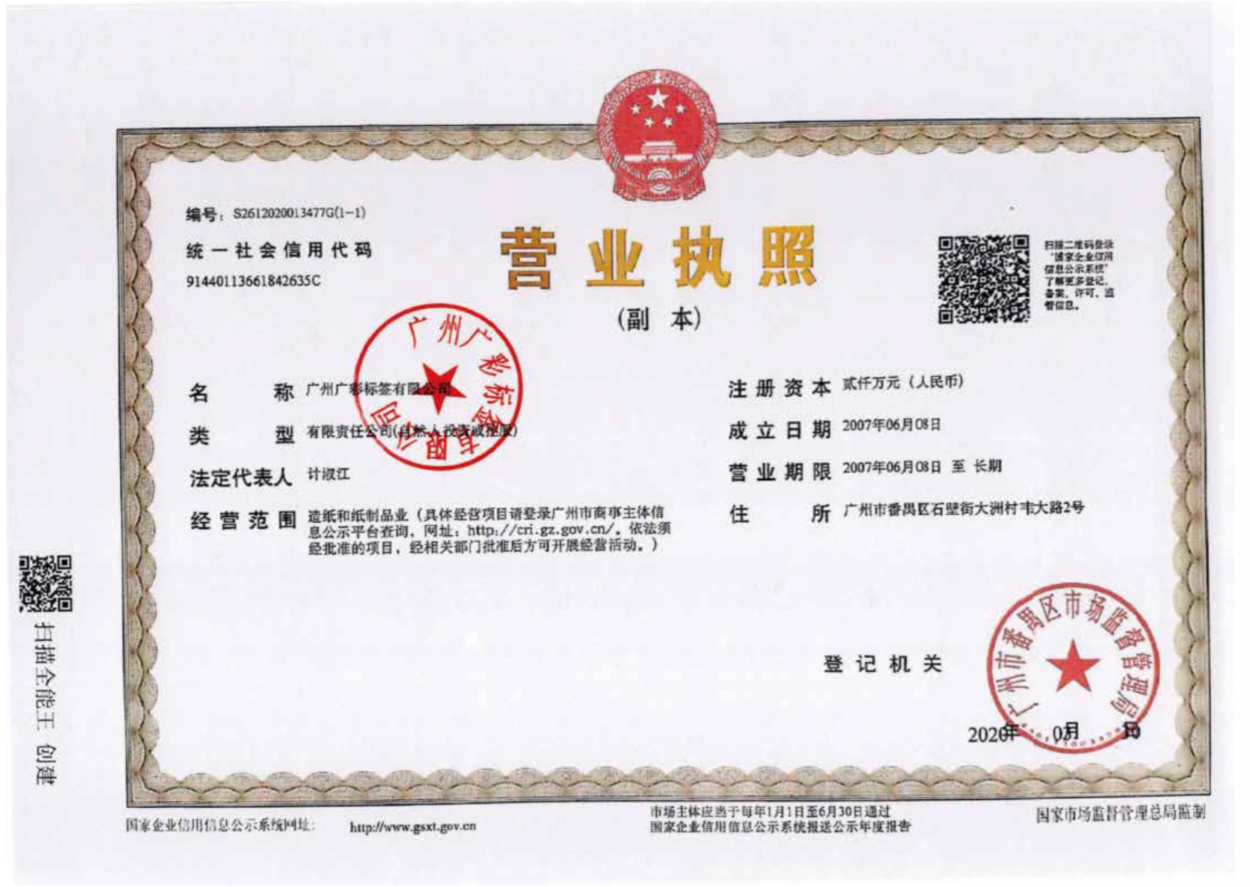
Copyright©2023 Guangzhou Guangcai Label Co., Ltd. ALL RIGHTS RESERVED. | SEO Tags | Business License | Cloud information | city substation