
NEWS CENTER
The company has always adhered to the "integrity, team, hard work, innovation" concept of the company, and constantly
surpass themselves. In line with the purpose of taking advantage of the society and serving the society, we will develop
together with our friends.
Treatment of Ink Dropping Problem in Self-adhesive Label Printing
time:
2018/05/10
Source:
many self-adhesive label manufacturers will encounter the same problem when printing. during the label printing process of film materials, it is easy to have the problem of surface printing off ink, which greatly affects the quality of printed matter and even delays the delivery date. This paper attempts to summarize and list the common causes and improvement methods of ink drop from the daily printing experience, for the industry to discuss together, in order to find the best solution.
problem 1: coating defects
regular films are divided into 2 types with coating and without coating, and the causes of ink drop caused by film coating defects are correspondingly divided into two situations: for coated film materials, if the surface coating firmness is poor, it will cause poor ink adhesion; however, uncoated film materials often cause ink to drop due to poor combination fastness of surface layer and ink.

ink drop caused by coating defects can be solved by the following methods: varnish printing treatment on the surface layer is adopted to protect the ink surface layer and play a role in preventing ink drop; The surface layer is treated with corona, and the corona dyne value on the surface of the material shall not be less than 38 mm/m, dyne value lower than 36 mm/m will directly affect the firmness of printing ink; The surface layer is primed or the use of an enhancer with strong ink adhesion (the blending ratio is about 3%) can also improve the inking force of the film surface layer. Some sub-face synthetic paper materials are not suitable for testing with 3M adhesive tape because the surface coating has certain paper coating characteristics.
problem 2: tension
for corona-treated film materials on the printing surface, to achieve good ink wetting, the dyne value usually needs to be above 38 mm/m, and it is easy to drop ink below 36 mm/m. At the same time, the dyne value of this material will gradually fade with time, resulting in the problem of printing off ink. The essence of this 1 problem is the tension problem.
for the ink drop caused by this situation, there are the following solutions: use satellite rotary machine with online corona function to carry out online corona treatment to improve the surface energy of film materials; Take intermittent printing machine can carry out surface primer coating treatment to improve the surface printing adhesion; When the dyne value fades, corona treatment is needed for printing, however, the size of the dyne value does not fully represent the adhesion between the ink and the surface material. Generally, the fading period of the dyne value is 3 months to 6 months, so it is recommended to minimize the long-term storage of raw materials in stock.
Finally, recommend the use of higher adhesion type of ink, it is recommended to ink suppliers.
problem 3: ink drying and tension
in the printing process, ink drying and tension may also cause off ink. Specifically divided into: printing ink layer is too thick resulting in incomplete drying; UV lamp energy is insufficient lamp aging, lamp reflector aging, resulting in UV lamp drying and curing is not sufficient, the ink layer is not dry; excessive drying of ink, resulting in material deformation, the formation of ink layer off.
this ink drop problem can be solved in the following three ways:
first, the use of deep ink thin printing is commonly known as reducing the amount of ink, such as spot color ground ink, which can be matched deeper. when formal printing, the amount of ink is smaller to achieve the sample effect. at the same time, the output power of UV lamp is increased, the printing speed is reduced, and the irradiation time by UV lamp is increased, achieve drying effect. This solution is suitable for old intermittent or satellite rotation machines and old UV lamp solutions.
second, check whether the UV lamp aging, and clean the reflector. Generally, the service life of domestic UV lamps is about 500-1000 hours, and that of imported lamps is about 1000-2500 hours. For details, please refer to the actual use. It is recommended that the printing plant clean the UV lamp every six months or so to ensure normal use.
third, reduce the output power of UV lamp. the specific operation is to print live parts in general printing factories. most of the first several groups of colors in the color sequence are standard or small characters. the required light is limited. the UV lamp can be turned on to illuminate. the light can be dried. the high-grade excessive irradiation is not allowed. because the heat energy absorbed by the thin film material is limited, excessive irradiation will cause the film material to curl, deform and become brittle, and the ink adhesion, can follow the first low-end after the high-end UV lamp use principle.
problem 4: ink and material matching
Finally, the degree of ink and material matching will also cause off ink to a certain extent. For example, the use of ink molecular tension is too large, can not form a uniform ink layer on the surface of the substrate material; or the use of more than the shelf life of the ink model or inferior domestic brand ink, will cause printing off ink.
summary of influencing factors of ink dropping
through the above analysis, we can sum up eight major reasons for ink dropping:
1. coated film materials have poor surface coating fastness;
2. uncoated film materials have poor combination fastness with ink after printing;
3, dyne value is low. For the printing surface of the corona treated film material, to achieve good ink wetting, dyne value usually need more than 38 mm/m;
4, dyne value fade, the printing surface for the corona treated film material, the dyne value may gradually fade with time, fade cycle is 3-6 months;
5. the ink layer is too thick and the UV lamp power is insufficient, resulting in insufficient curing of the ink layer;
6. the ink tension is too large to form a uniform cured ink layer on the surface of the printing material;
7. use expired ink or inferior domestic ink;
8. the ink is excessively irradiated and dried.
in case of the above situation, it can be cut into ink that matches the printing material, such as film-specific ink and light-resistant and light-resistant ink (for specific consultation with ink manufacturers); For expired ink, printing tests should be done before printing, or some simple words or small logo patterns should be printed, as well as some low-grade products should be printed; printing large area field and full plate network pattern, recommend use good brand, high adhesion performance ink.
Related News
2020-06-12
The convenience of label and the development of label printing
The emergence of labels has greatly improved work efficiency and accelerated the pace of urban life. In the face of various printing methods, in order to shorten the equipment debugging time, improve productivity, improve product quality to a certain extent, and meet the needs of customers, label printing factories generally classify products according to different grades and different batches of daily necessities. Then use different printing methods for printing.
2019-08-05
Under the background of "new engineering", the training of printing professionals has new ideas!
In order to study, publicize and implement Xi Jinping's thoughts on socialism with Chinese characteristics in the new era and the spirit of the 19th National Congress of the Communist Party of China, implement the deployment of the National Propaganda and Ideological Work Conference, and undertake the mission of "raising the banner, gathering people's hearts, cultivating new people, promoting culture, and exhibiting image" The printing industry better serves the prosperity and prosperity of my country's socialist culture and leads high-quality development. The National Press and Publication Administration hosted the China Printing Industry Innovation Conference, build a political position that dominates development and a service platform for collaborative innovation. The theme of this year's conference is "focusing on greening", organizing and mobilizing the strength of the whole industry to jointly participate in the preparation and holding of the conference, preaching policies and regulations, and informing development
2019-08-05
Break down technical barriers! China's inkjet print head can no longer rely on foreign technology
A few days ago, the ZTE incident came to life after a storm. This crisis without gunpowder smoke has triggered a discussion among Chinese people about independent core technologies. In fact, in the 3D printing industry, there are many domestic technology subject to foreign, piezoelectric inkjet print head is one of them. China's "storm" strong counter-attack piezoelectric inkjet print head in the sand 3D printer, as the chip in the semiconductor, the importance is self-evident. Previously, companies such as German Voxeljet and Exone in the United States have already had relatively mature commercial applications in sand mold 3D printing technology, while Chinese companies limited to nozzles have few brands.
2019-08-05
Digital printing will cross the label, rapid development in all areas of packaging
Mr. MichaelFairley believes that label processors still have time to find new business opportunities in the production of flexible packaging and folding cartons with their understanding, expertise and skills in digital printing. At the 2019 Asia International Label Printing Exhibition (LabelexpoAsia2019) held at the Shanghai New International Expo Center from December 3 to 6 this year, about 30 digital printing equipment-related manufacturers participated in the exhibition, including: u.S. Amica (Amica), Domino, Dilli, Haotian, Konica Minolta, Runtianzhi, Yunbo (Shanghai) Internet of Things Technology, Changzhou Temine, Hefei Runjie, Nebula Computer (GCC), Hanhua Industry, Saikang, Zhuo Jue, Dragan and Ningbo Worry, etc. Among these exhibitors, the use of inkjet technology accounts for the vast majority, thanks to the rapid development of nozzle technology, the improvement of printing materials and ink formulations, and the unprecedented progress made by color inkjet printers in terms of performance and market applications. The development of digital printing in the label industry has been more than 20 years. The first to enter this field was toner technology, followed by inkjet technology, and now Landa's nano digital printing technology. This is 20 years of rapid development. So far, the global label industry has installed about 4500 digital printing machines, of which HPIndigo and Saikang toner printing machines account for more than 2/3 of the total installed capacity.

Head office: Guangzhou Guangcai Label Co., Ltd.
Address (Add): No.2, Wei Da Lu, Dazhou Village, Shibi Street, Panyu District, Guangzhou
Foshan Branch: Guangdong Guangcai Label Co., Ltd
Address (Add): 8th Floor, Building 15, Haichuang Dazu Robot Manufacturing Center, No. 3 Erzhi Industrial Avenue, Xihai Village, Beijiao Town, Shunde District, Foshan City
Shanghai Branch: Guangcai Label (Shanghai) Co., Ltd.
Address of Shanghai Branch (Add): Building 4, 626 Baoyuan Fifth Road, Jiading District, Shanghai
Jiangxi Branch: Guangcai Label (Jiangxi) Co., Ltd
Jiangxi Branch Address (Add): Within the Pharmaceutical and Chemical Industry Base of Tianfan Street Industrial Park, Poyang County, Shangrao City, Jiangxi Province
Wechat Public
Copyright©2023 Guangzhou Guangcai Label Co., Ltd. ALL RIGHTS RESERVED. | SEO Tags | Business License | Cloud information | city substation
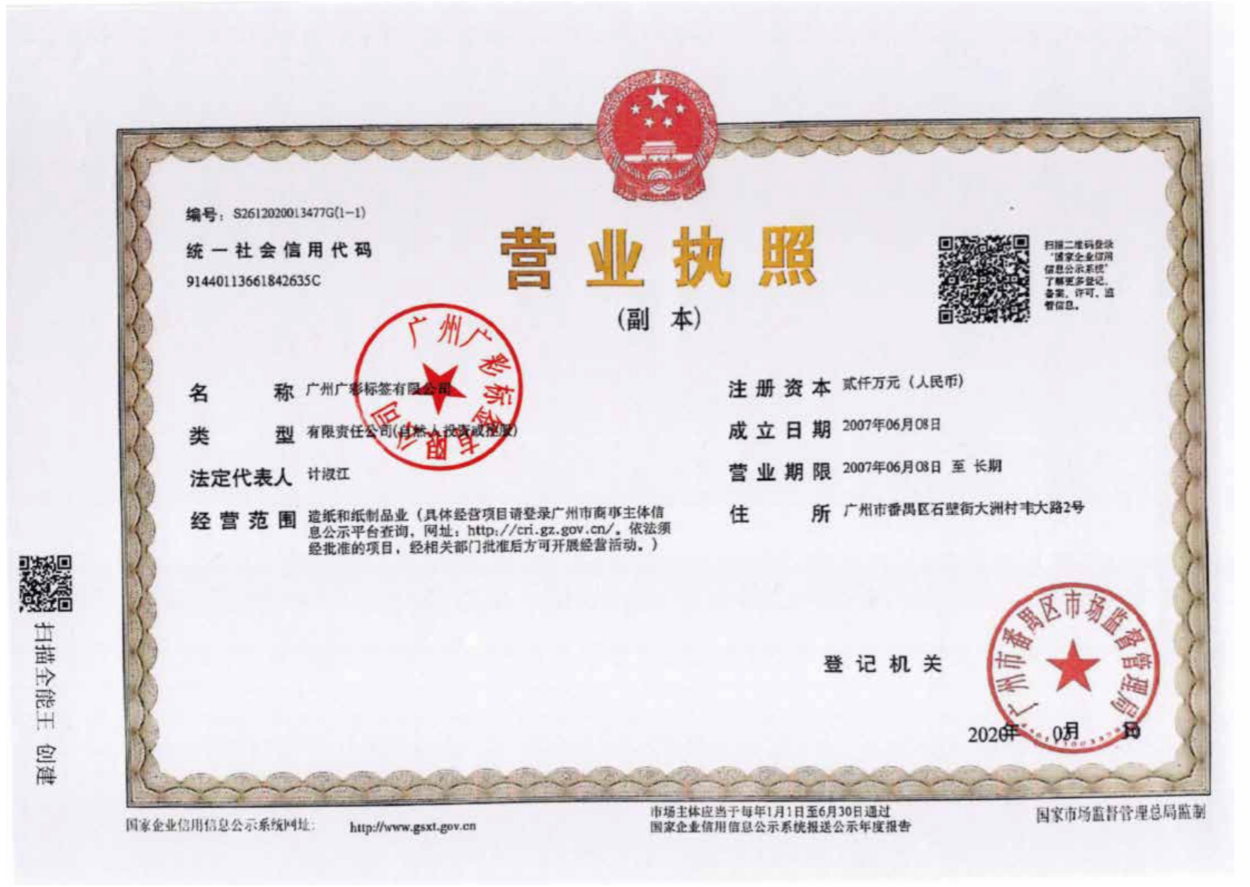
Copyright©2023 Guangzhou Guangcai Label Co., Ltd. ALL RIGHTS RESERVED. | SEO Tags | Business License | Cloud information | city substation