
NEWS CENTER
The company has always adhered to the "integrity, team, hard work, innovation" concept of the company, and constantly
surpass themselves. In line with the purpose of taking advantage of the society and serving the society, we will develop
together with our friends.
Recycling, adhesive waste can be treated in this way
time:
2019/10/10
Source:
on July 1, the "Shanghai municipal solid waste management regulations", which is known as the most stringent in history, was officially implemented and. As a result, all walks of life are striving to reduce the amount from the source, reduce the production of packaging pollution, and improve the recycling rate of waste products and packaging materials.
Environmental Pressure Pushes Industry Upgrading
Currently, green environmental protection and sustainable development are global propositions. In recent years, the Chinese government has continuously increased environmental protection supervision, especially enterprises located in Jiangsu, Zhejiang and Shanghai regions and industrial parks have been able to clearly feel the pressure brought by the increase in waste disposal costs. Some companies have even been punished by local regulators for improper waste disposal.
On June 5, 2019, the State Council Executive Meeting passed the Law on the Prevention and Control of Environmental Pollution by Solid Waste in the People's Republic of China (Revised Draft). On the basis of the existing provisions on compensation for pollution damage, the revised law on the prevention and control of environmental pollution by solid waste adds provisions such as the inversion of the burden of proof, and supplements the provisions on the extended liability of producers. If the dumping and stacking of solid waste to rivers, lakes, canals, channels, reservoirs and beach bank slopes below the highest water level are prohibited by laws and regulations, it will touch the "red line" of the law ". Environmental pressure is forcing the industry to complete the transformation and upgrading as soon as possible.
In the past, China's printing industry has been developing extensively, and domestic enterprises mainly landfill self-adhesive waste. Landfill not only occupies a large amount of land area, and waste leakage liquid will pollute groundwater resources for a long time. Therefore, this method not only fails to realize the resource treatment of garbage, but also has great potential harm and will bring endless troubles to future generations. At present, many developed countries ban landfill waste.
Throughout the life of a sticker, the waste generated mainly includes adhesive base paper, adhesive surface material after die cutting and waste discharge, adhesive surface material pasted on the end product and adhesive waste material.
Processors can also get more carbon dioxide reduction benefits when using lighter materials, such as saving storage and logistics space; can reduce the number of reels and downtime, improve production efficiency; greatly reduce the exploitation of natural resources, reduce production waste, reduce waste disposal costs.
therefore, economic benefits and environmental protection do not conflict with each other, but complement each other. the total cost of non-adhesive materials will be significantly improved.
Finland Lantai label said that after understanding the source of the main "adhesive waste" targeted to produce ".
At present, there are two major sources of adhesive waste: 1 is label printing factory or bottle factory; The 1 factory is label printing line; the waste produced by the two is not the same. The main waste generated by the label printing plant is die-cutting waste and trimming waste. Among them, die-cutting waste components are mixed, and most of them need to be landfilled and incinerated due to glue and ink. The composition of the trimming waste is the same as the label release substrate, and the utilization value is higher, but the part of the waste produced by the printing plant is less, which is not convenient for centralized transportation.
The main waste materials produced by the labeling line of brand factories or bottling factories are label release film and PE paper. This part of the waste quantity is large, and the use value is very high, most of the current will be recycled. For example, PET film degradation treatment can be made into recycled PET fiber material; Glassine paper can be degraded into other types of paper, such as corrugated paper.
In order to give this part of self-adhesive waste a new life, starting from 2018, in Asia, UPM Labels has started to provide recycling solutions for label waste with RafCycle projects to optimize the use of raw materials during their life cycle. The implementation of the project responds to the extended producer responsibility system promoted by the Chinese government and the 2030 sustainable development goals set by the United Nations. It uses Lantai's leading R & D capabilities and developed logistics network to provide practical waste solutions for downstream enterprises.

The implementation of the RafCycle project has given brand-new life to the owners of label backing paper waste, bringing considerable profits to printers, packers and brands, it also brings great benefits to the environment.

Scientific Innovation Improves Environmental Efficiency strong>
New Plastics Economy Global Commitment

• Provide label materials to reduce unnecessary plastic packaging.
• Develop packaging and labeling solutions that promote re-use.
• 100 per cent of all plastic packaging used in production units is reusable, recyclable or degradable by 2025.
• As part of The Biofore Company, UPM is actively developing renewable alternative labeling solutions to move towards a "net benefit" economy beyond fossil energy.
Smart tags create the future
Labels are critical to the sustainability of packaging and play a unique role in promoting a circular economy. For this reason, UPM has been sparing no effort to reduce unnecessary plastic packaging and is constantly developing innovative recyclable materials and solutions to meet the needs of the future to help customers and brand terminals realize their respective commitments to the circular economy.
Related News
2020-06-12
The convenience of label and the development of label printing
The emergence of labels has greatly improved work efficiency and accelerated the pace of urban life. In the face of various printing methods, in order to shorten the equipment debugging time, improve productivity, improve product quality to a certain extent, and meet the needs of customers, label printing factories generally classify products according to different grades and different batches of daily necessities. Then use different printing methods for printing.
2019-08-05
Under the background of "new engineering", the training of printing professionals has new ideas!
In order to study, publicize and implement Xi Jinping's thoughts on socialism with Chinese characteristics in the new era and the spirit of the 19th National Congress of the Communist Party of China, implement the deployment of the National Propaganda and Ideological Work Conference, and undertake the mission of "raising the banner, gathering people's hearts, cultivating new people, promoting culture, and exhibiting image" The printing industry better serves the prosperity and prosperity of my country's socialist culture and leads high-quality development. The National Press and Publication Administration hosted the China Printing Industry Innovation Conference, build a political position that dominates development and a service platform for collaborative innovation. The theme of this year's conference is "focusing on greening", organizing and mobilizing the strength of the whole industry to jointly participate in the preparation and holding of the conference, preaching policies and regulations, and informing development
2019-08-05
Break down technical barriers! China's inkjet print head can no longer rely on foreign technology
A few days ago, the ZTE incident came to life after a storm. This crisis without gunpowder smoke has triggered a discussion among Chinese people about independent core technologies. In fact, in the 3D printing industry, there are many domestic technology subject to foreign, piezoelectric inkjet print head is one of them. China's "storm" strong counter-attack piezoelectric inkjet print head in the sand 3D printer, as the chip in the semiconductor, the importance is self-evident. Previously, companies such as German Voxeljet and Exone in the United States have already had relatively mature commercial applications in sand mold 3D printing technology, while Chinese companies limited to nozzles have few brands.
2019-08-05
Digital printing will cross the label, rapid development in all areas of packaging
Mr. MichaelFairley believes that label processors still have time to find new business opportunities in the production of flexible packaging and folding cartons with their understanding, expertise and skills in digital printing. At the 2019 Asia International Label Printing Exhibition (LabelexpoAsia2019) held at the Shanghai New International Expo Center from December 3 to 6 this year, about 30 digital printing equipment-related manufacturers participated in the exhibition, including: u.S. Amica (Amica), Domino, Dilli, Haotian, Konica Minolta, Runtianzhi, Yunbo (Shanghai) Internet of Things Technology, Changzhou Temine, Hefei Runjie, Nebula Computer (GCC), Hanhua Industry, Saikang, Zhuo Jue, Dragan and Ningbo Worry, etc. Among these exhibitors, the use of inkjet technology accounts for the vast majority, thanks to the rapid development of nozzle technology, the improvement of printing materials and ink formulations, and the unprecedented progress made by color inkjet printers in terms of performance and market applications. The development of digital printing in the label industry has been more than 20 years. The first to enter this field was toner technology, followed by inkjet technology, and now Landa's nano digital printing technology. This is 20 years of rapid development. So far, the global label industry has installed about 4500 digital printing machines, of which HPIndigo and Saikang toner printing machines account for more than 2/3 of the total installed capacity.

Head office: Guangzhou Guangcai Label Co., Ltd.
Address (Add): No.2, Wei Da Lu, Dazhou Village, Shibi Street, Panyu District, Guangzhou
Foshan Branch: Guangdong Guangcai Label Co., Ltd
Address (Add): 8th Floor, Building 15, Haichuang Dazu Robot Manufacturing Center, No. 3 Erzhi Industrial Avenue, Xihai Village, Beijiao Town, Shunde District, Foshan City
Shanghai Branch: Guangcai Label (Shanghai) Co., Ltd.
Address of Shanghai Branch (Add): Building 4, 626 Baoyuan Fifth Road, Jiading District, Shanghai
Jiangxi Branch: Guangcai Label (Jiangxi) Co., Ltd
Jiangxi Branch Address (Add): Within the Pharmaceutical and Chemical Industry Base of Tianfan Street Industrial Park, Poyang County, Shangrao City, Jiangxi Province
Wechat Public
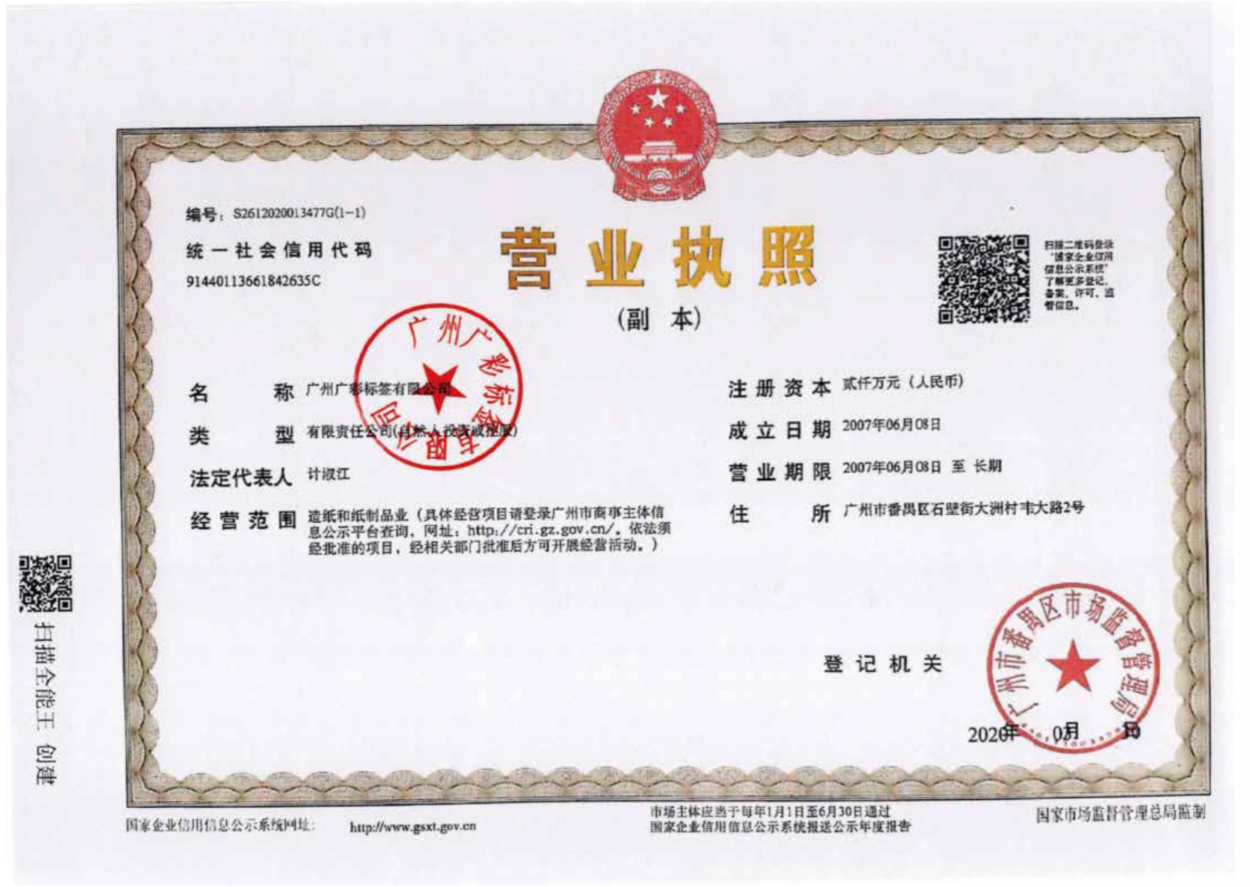
Copyright©2023 Guangzhou Guangcai Label Co., Ltd. ALL RIGHTS RESERVED. | SEO Tags | Business License | Cloud information | city substation
Copyright©2023 Guangzhou Guangcai Label Co., Ltd. ALL RIGHTS RESERVED. | SEO Tags | Business License | Cloud information | city substation